
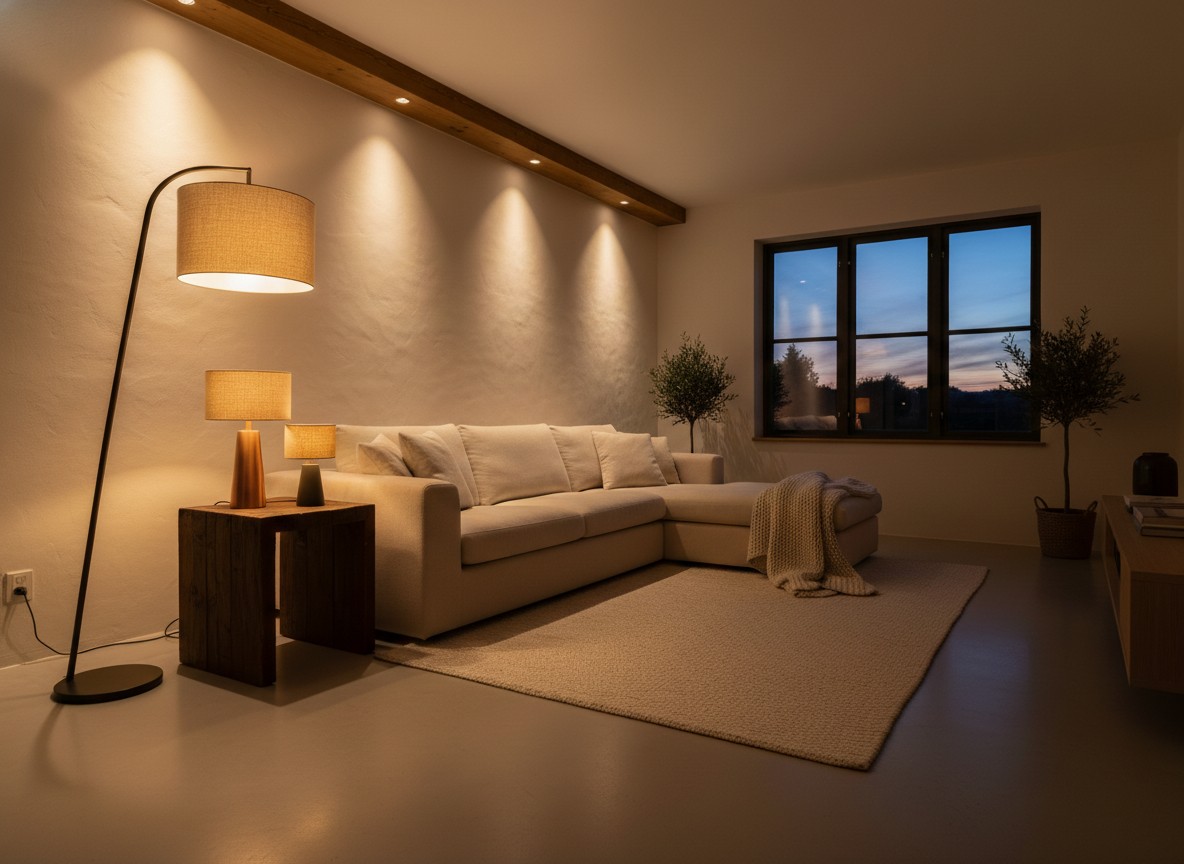
Layered lighting transforms living rooms from flat, one-dimensional spaces into dynamic environments that adapt to activities, time of day, and mood. This guide breaks down the three essential layers and shows you how to combine them effectively.
Understanding the Three Layers
Professional lighting design relies on three distinct layers, each serving a specific purpose. Master these, and you master living room lighting.
Layer 1: Ambient Lighting (General Illumination)
Purpose: Overall illumination that allows safe movement through the space
Sources: Ceiling fixtures, recessed lights, chandeliers, large pendant lights
Effect: Fills the room with general light, sets baseline brightness
Layer 2: Task Lighting (Functional Light)
Purpose: Focused illumination for specific activities—reading, working, hobbies
Sources: Floor lamps, table lamps, desk lamps, adjustable wall sconces
Effect: Provides adequate light for visual tasks without causing eye strain
Layer 3: Accent Lighting (Decorative Light)
Purpose: Highlights architectural features, artwork, or creates visual interest
Sources: Picture lights, wall sconces, uplights, LED strips
Effect: Adds depth, drama, and sophistication to the space
Layer 1: Ambient Lighting Fundamentals
Ambient light forms your foundation. Done well, it's barely noticed. Done poorly, everything else fails.
Ceiling-Mounted Options
Recessed lighting: Discreet and modern, recessed lights provide clean general illumination. Install them in a grid pattern, spacing them appropriately for your ceiling height:
- 8-foot ceilings: Space lights 4 feet apart
- 9-foot ceilings: Space lights 4.5 feet apart
- 10-foot ceilings: Space lights 5 feet apart
Flush mount or semi-flush fixtures: When recessed lighting isn't possible, ceiling-mounted fixtures provide ambient light while adding design interest. Choose fixtures that distribute light broadly rather than focusing it downward.
Chandeliers or large pendants: In living rooms with adequate height, a statement chandelier can serve as both ambient light and visual focal point. Ensure it's centered in the seating area, not necessarily the room.
Getting Ambient Light Right
The key to good ambient lighting is adequate brightness without harshness:
- Install dimmers: Essential for adjusting light levels throughout the day and for different activities
- Use multiple fixtures: Several moderate sources create better light than one bright fixture
- Consider color temperature: 2700K-3000K (warm white) works best for living spaces
- Avoid over-lighting: Ambient light should illuminate, not spotlight. Aim for soft, diffused light
Layer 2: Task Lighting Essentials
Task lighting addresses specific needs. Where do you read? Work? Pursue hobbies? Each activity requires targeted illumination.
Floor Lamps for Reading
Reading lamps should provide 300-500 lumens directly on reading material without glare:
Arc floor lamps: Curve over seating areas, positioning light exactly where needed. Excellent for sofas and chairs positioned away from walls.
Traditional floor lamps: Stand beside chairs or at sofa ends. Look for adjustable heads that direct light downward onto pages.
Tripod floor lamps: Provide both ambient and task lighting depending on shade design. Choose opaque shades that direct light downward for task focus.
Table Lamps
Table lamps on side tables, consoles, or end tables create cozy task lighting pools:
- Height matters: The bottom of the lampshade should sit at eye level when seated (typically 40-42 inches from floor for standard seating)
- Shade material: Opaque shades direct more light downward for tasks. Translucent shades provide softer, more diffused light
- Bulb brightness: 60-75 watt equivalent (800-1100 lumens) works well for most reading tasks
Strategic Placement
Position task lighting where activities actually occur:
- Beside reading chairs
- At desk work areas
- Near hobby or craft spaces
- Flanking sofas for symmetry and function
Common mistake: Placing lamps for visual balance rather than functional need. Beautiful symmetry is useless if no one sits there.
Layer 3: Accent Lighting for Depth
Accent lighting separates good rooms from exceptional ones. It adds dimension, highlights what matters, and creates visual interest.
Highlighting Artwork
Picture lights or adjustable track lighting draw attention to paintings, photographs, or wall art:
- Mount picture lights directly on frames or above artwork
- Position track lights at 30-degree angles to artwork for minimal glare
- Use LED options to prevent heat damage to valuable pieces
- Dim accent lights with ambient lighting for balanced visibility
Architectural Features
Use lighting to emphasize room character:
Uplighting: Place small LED fixtures behind plants or in corners, casting light upward to highlight ceiling texture or create ambient glow.
Wall washing: Install wall sconces or vertical light strips to graze textured walls, exposing surface detail.
Shelf lighting: LED strips inside bookcases or display shelves transform storage into features.
Decorative Fixtures as Accent Light
Sometimes the fixture itself is the accent:
- Statement table lamps with sculptural bases
- Decorative wall sconces
- Unique floor lamps serving as art pieces
These fixtures provide light but function primarily as design elements, drawing the eye and adding personality.
Combining the Layers
Each layer alone is insufficient. Magic happens when they work together.
The Evening Sequence
Understanding how layers interact throughout the day helps you design effectively:
Late afternoon (ample natural light):
- Ambient: Off or very low
- Task: Off unless actively reading/working
- Accent: Off
Early evening (natural light fading):
- Ambient: Low level via dimmed ceiling lights
- Task: On where activities occur
- Accent: Begin turning on for ambiance
Night (no natural light):
- Ambient: Moderate level or off entirely
- Task: On as needed
- Accent: On to create layered, dimensional lighting
Scenario-Based Lighting
Different activities demand different combinations:
Reading:
- Task light at full brightness near reading location
- Ambient light dimmed to 20-30%
- Accent lights on for atmosphere
Watching TV:
- Ambient light off or very low
- Task lights off except behind TV (reduces eye strain)
- Accent lights dimmed for subtle background illumination
Entertaining:
- Ambient light at 40-60% for comfortable visibility
- Task lights on to create warmth throughout space
- Accent lights on to highlight room features
Relaxing:
- Ambient light off
- Task lights on low or off
- Accent lights as primary source for cozy ambiance
Practical Implementation Guide
Starting from Scratch
If you're building your lighting plan from zero:
- Install ambient layer first: Establish baseline illumination via ceiling fixtures or recessed lighting
- Add task lighting: Place lamps near seating and work areas
- Introduce accent lighting: Highlight features and add dimension
- Fine-tune: Adjust brightness, positions, and combinations until it feels right
Improving Existing Lighting
If you already have some fixtures:
Evaluate what you have:
- Identify which layers exist
- Note gaps (no task lighting? no accent lights?)
- Observe which areas feel too bright or too dim
Add missing layers:
- Overhead only? Add floor and table lamps
- Just lamps? Add accent lighting or improve ambient sources
- Everything but accents? Introduce decorative elements
Upgrade controls:
- Install dimmers on all circuits possible
- Use smart bulbs in existing fixtures for easy dimming
- Consider scene controllers that save lighting combinations
Common Mistakes and How to Avoid Them
Over-reliance on overhead lighting: A single ceiling fixture, no matter how bright, cannot create layered illumination. It produces flat light with harsh shadows.
Under-wattage lamps: Using 40-watt bulbs where 75-watt equivalents are needed makes task lighting ineffective. Don't sacrifice brightness for aesthetics.
All lights at the same height: Lamps all at 60 inches creates monotonous horizontal plane. Vary heights—floor lamps, table lamps, wall sconces—for visual interest.
Ignoring dimmers: Fixed brightness lighting limits flexibility. Dimmers transform single-function lights into multi-scenario solutions.
Wrong color temperature: Mixing cool and warm white bulbs creates uncomfortable discord. Stick to 2700K-3000K throughout living spaces for cohesion.
Forgetting corners: Dark corners make rooms feel smaller and unwelcoming. Place accent lighting in corners to push visual boundaries outward.
Budget-Friendly Layering
Layered lighting doesn't require massive investment:
Start with dimmers: $15-30 per switch transforms existing fixtures into adjustable layers.
Add one quality floor lamp: $100-300 introduces task lighting exactly where needed.
Use smart bulbs: $10-15 per bulb adds dimming and color temperature control to existing fixtures without rewiring.
DIY accent lighting: $20 plug-in LED strips behind furniture or under shelves create accent lighting without installation.
The key is thoughtful placement, not expensive fixtures. A $150 floor lamp positioned correctly creates more impact than a $500 chandelier in the wrong spot.
Layer Your Living Room Lighting
Explore our collection of floor lamps, table lamps, and accent lighting designed for beautifully layered spaces. Free shipping on all orders.
Shop Living Room Lighting